
Guided by Vision, Heard Through Sound: AU Students Build Navigation Tech for the Visually Impaired
Staff Writer
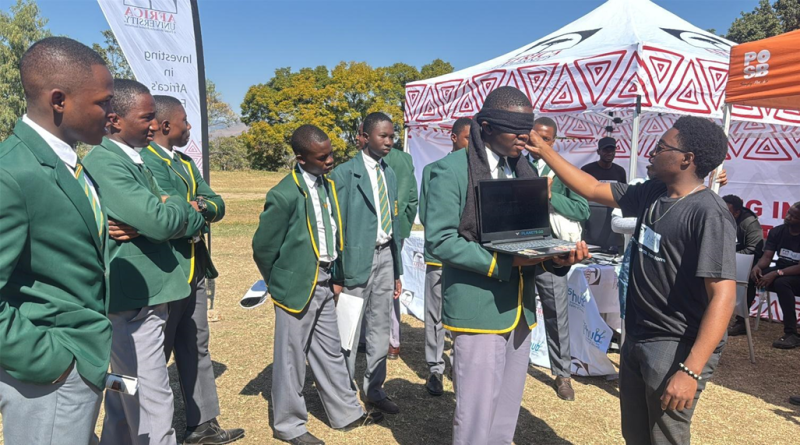
A team of Africa University students from the College of Engineering and Applied Sciences (CEAS) has developed an Object Detection System (ODS) to empower visually-impaired people with the ability to move safely, confidently, and independently.
The ODS is a wearable, smart navigation system that leverages stereo cameras and computer vision to detect obstacles. The system then alerts users about obstacles in their path effectively allowing them to “hear” their surroundings in 3D.
This innovation, which began as a capstone project saw the 12 students Munyaradzi Mzite – Project Manager teaming up with Tadiwanashe Tasara, Anesu Nyakonda – Software Developers, Trevor Mparutsa, Tinotenda Muzembe – Electronics Engineers, Farai Chiura, Takunda Mudawarima – HCI Specialists, Tafadzwa Mwerenga, Sean Mukome, Munashe Masunda – Quality Assurance, Chantal Nyikadzino – Researcher and Takudzwa Tawodzera – Technical Writer, under the mentorship of their academic supervisor Ms. L. Thembani as well as Mr Dhlakama to respond directly to real-world mobility challenges faced by the visually-impaired in Zimbabwe and across Africa.
“It’s been an incredibly inspiring experience to lead a team so passionate about computer science and building inclusive technology. What started as class project idea is now something real. Seeing individuals walk with confidence using our system guided by sound during our testing reminded us why we do what we do. We are committed to seeing this project through and make it accessible to those who need it most. We thank our university, the IECC and our lecturers who believed in the vision,” team leader, Mr Mzite said.

Lack of safe, real-time mobility technology contributes to social exclusion, economic vulnerability, and lost opportunities. This ODS thus, was designed to bridge that gap. The team’s collaborative effort dovetails with Education 5.0, where learners must innovate for national and in Africa University’s case, the continent’s transformation.
As a student-centred institution, AU continues to scale up support for student-led innovation and holistic leadership education that will transform Africa’s future, in line with its Strategic Goal of enhancing Student Access and Success. Through the Africa University Innovation, Entrepreneurship and Commercialization Centre (IECC), the project will now be refined, validated, and commercialized to ensure that this solution reaches the people who need it the most.
Innovation Officer at the IECC. Mr Terry Gomera shed more light on the next steps. “We have taken on the next phase of this solution. Our current focus is on transforming the prototype into a robust, validated, and deployable product,” he said.
“We will actively engage with stakeholders, especially the would-be users to co-design the final version and ensure real-world usability. This innovation demonstrates what’s possible when we unlock the potential of students under Education 5.0. It’s a made-in-Africa solution for a global challenge and we are proud to lead its journey to impact,” Mr Gomera added.
